
Scores
A score is fit for this search, not a verdict on the person's career.
The number on a row answers one question: how well does this person match what you asked for?
It is not a personality test, and it is not are they hireable in general.
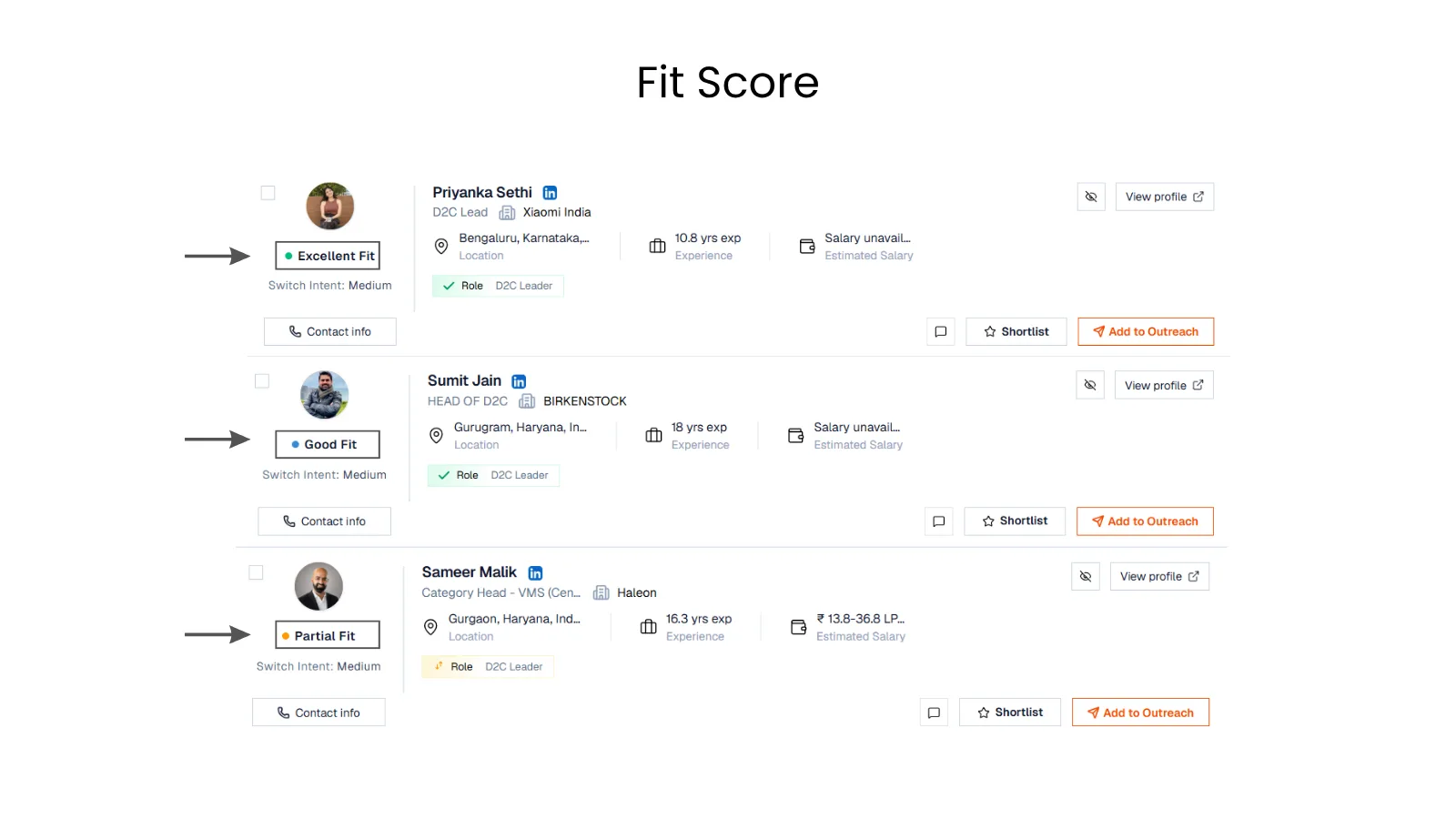
Score and fit on a row
Close crop of a results row showing a numeric match score and a fit label such as Excellent Fit or Good Fit.
Score and fit on a row
Close crop of a results row showing a numeric match score and a fit label such as Excellent Fit or Good Fit.
What goes into the number
SARAL looks at the same things you would:
- Does the role line up with their titles and related work?
- Is experience in the range you asked for?
- Do the skills show up in a believable way?
- Are they in the location you required?
- Do the fuzzier asks hold up when you read the profile (SaaS, leadership, a domain, a language)?
Location is the hard gate. The rest moves the score. Fuzzy asks nudge people up or down. They do not silently erase a strong match.
Labels you will see
| Label | Score | How to treat it |
|---|---|---|
| Excellent Fit | 85+ | Open first. Likely worth a conversation if the profile holds up. |
| Good Fit | 60-84 | Solid. Read two or three. |
| Partial Fit | 30-59 | Use when the top is thin, or you want a different shape of person. |
| Low Fit | below 30 | Audit when you are stuck or checking the model's taste. |
You are allowed to disagree with a number. That is why the profile exists.
How to use scores without worshipping them
- Trust the order more than the exact digit. 84 versus 81 is not a story.
- Open a high score and a mid score. If your gut and the number disagree, rewrite the search.
- Do not unlock twenty mid scores hoping contact data will make them better.
If something in the system cannot finish a deeper read of the profile, you still get a ranked list. You will never see a fake explanation invented to fill a gap.